
What are Writs? Types, Uses, and Legal Rights Explained
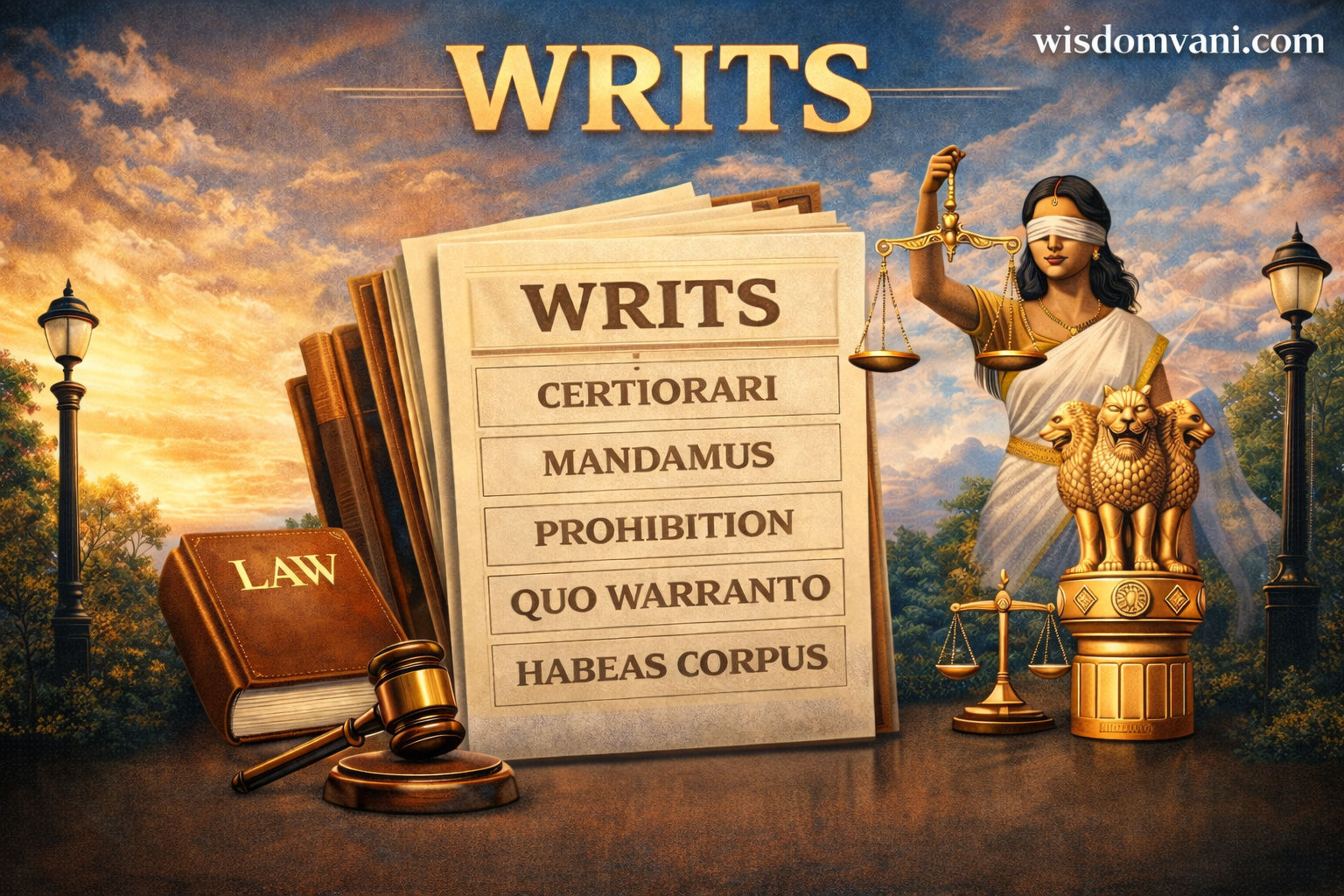
Have you ever felt like a government authority was acting unfairly, or that your basic rights were being ignored by the system?
In a democracy, the law isn’t just a set of rules for citizens to follow; it’s also a leash for the government.
The primary tool used to keep that leash tight is called a Writ. In this article, we’ll explore what a writ is, when it’s used, and the five specific types available to protect your freedom.
What is a Writ?
In simple terms, a Writ is a formal written order issued by a court of law. Think of it as a "legal command." It directs a person, an officer, or a lower authority to do something or to stop doing something.
In the Indian legal context (and many other common law systems), Writs are the primary mechanism for enforcing Fundamental Rights. If your rights are violated, you don't always have to go through years of lower-court battles; you can approach the High Court or the Supreme Court directly to seek a Writ.
When is a Writ Used?
Writs are generally used as a "remedy of last resort" or when an immediate intervention is needed to prevent injustice. You would typically seek a writ when:
Your fundamental rights (like freedom of speech or personal liberty) are violated.
A public official fails to perform their legal duty.
A lower court or tribunal exceeds its legal authority.
Someone is illegally detained or imprisoned.
The 5 Types of Writs
There are five main types of writs, each serving a very specific purpose. They are often referred to by their traditional Latin names:
1. Habeas Corpus (To have the body)
This is perhaps the most famous writ. It is used when a person is unlawfully detained or arrested.
Purpose: The court orders the person holding the detainee to bring them before the court to explain why they are being held.
The Result: If the detention is found to be illegal, the person is set free immediately.
2. Mandamus (We command)
This writ is issued to a public official, a lower court, or a government body that has failed to perform a mandatory duty.
Purpose: To wake up a "sleeping" authority and force them to do their job.
Example: If a government office refuses to process a permit that you are legally entitled to, a writ of Mandamus can be filed.
3. Prohibition (To forbid)
While Mandamus tells an authority to "start doing," Prohibition tells them to "stop doing."
Purpose: It is issued by a higher court to a lower court or a quasi-judicial body to prevent them from overstepping their jurisdiction.
The Result: It stays the proceedings before a judgment is passed.
4. Certiorari (To be certified)
This is similar to Prohibition but happens after a decision has been made.
Purpose: A higher court reviews a case decided by a lower court to check for legal errors or lack of jurisdiction.
The Result: If the lower court's order is found to be faulty, the higher court "quashes" (cancels) it.
5. Quo-Warranto (By what authority)
This writ is used to prevent "illegal usurpation" of a public office.
Purpose: It asks a person holding a public office, "By what authority are you holding this position?"
The Result: If the person cannot prove they are legally entitled to the office, they are removed.
Conclusion
Writs are the backbone of justice. They ensure that no one—no matter how powerful—is above the law. By understanding these five tools, you become a more informed citizen, capable of standing up for your rights and the rights of others.
Comments 0